What risks are associated with forest investing in Finland, and how can they be managed? In this article, we present expert views on forest damage risks and financial risks related to forest investing and explain how Suomen Sijoitusmetsät Oy manages these risks. A link to the thesis and further information on the results can be found at the end of the article.
Research background and objectives
Max Mäkäläinen’s Bachelor’s thesis, conducted for Suomen Sijoitusmetsät Oy, examines risk factors associated with forest investing in Finland. The specific objective of the study was to assess the probability of different risks materialising and their financial impacts through an expert survey. The risks were examined across three stages of forest development: young stands, growing forests and mature forests ready for regeneration. The theoretical background of the study covered Finland as a whole, while the survey focused on the risks of forest investing over the next ten years in North Karelia from the perspective of a private individual. This scope was chosen because the occurrence of risks such as forest damage can vary significantly between different regions of Finland, and risks affect private individuals differently from other ownership groups, such as institutional investors. The thesis also examined methods of risk management and how risks can be taken into account in forest valuation.
Research results: key financial and forest damage risks according to experts
- Key risks in young stands: rising forest management costs and damage caused by mammals (cervids)
- Key risks in growing forests: stumpage price risk and wind damage
- Key risks in mature forests ready for regeneration: stumpage price risk and insect damage
Analysis of the results
Overall, the risks were assessed as moderate, supporting the findings of previous studies that forest is still generally considered a low-risk investment. For some risks, the responses showed greater standard deviations, reflecting uncertainty about the future and differences in expert opinion. In addition, risks with a low probability but a high financial impact can have significant consequences if they materialise, even if they do not represent a major overall risk. Risk management is therefore an important part of forest investing.
The following scatter plots illustrate how the risks are positioned across the different stages of forest development. The table below the charts presents the exact values used to create the scatter plots. The axes of the scatter plots have been limited to the actual range of the observations.
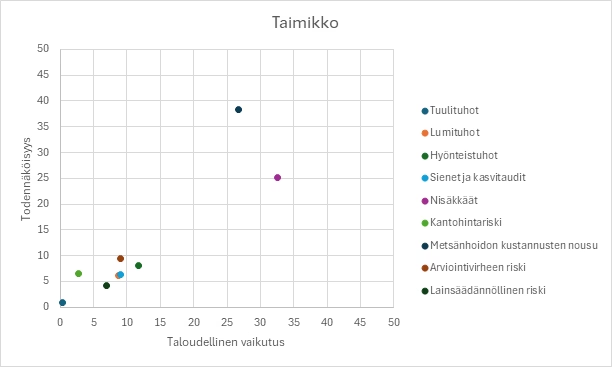
Figure 1. Average risk ratings in young stands
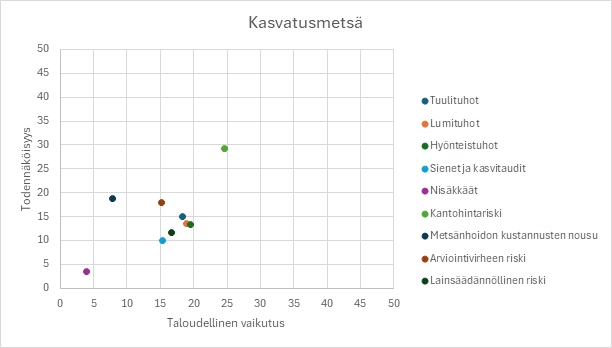
Figure 2. Average risk ratings in growing forests
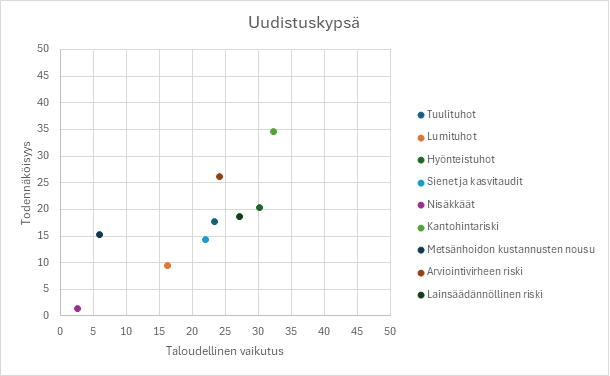
Figure 3. Average risk ratings in mature forests ready for regeneration
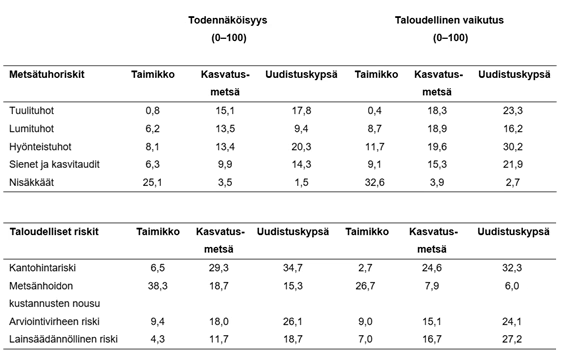
Table 1. Standard deviations of risk ratings
The full thesis is available here.
How does Suomen Sijoitusmetsät manage the risks of forest investing?
Asset management and forest management (jointly owned forest and other managed properties)
Metsänhaltija Joint Forest, for example, receives asset management and forest management services from Suomen Sijoitusmetsät. The approach is based on diversification, appropriate and timely measures, identification of risk factors and long-term planning. The forest area is distributed across several geographical regions and consists of stands of different ages and tree species, reducing the impact of individual risks such as wind damage and fluctuations in timber prices. Forest management is carried out by professionals who ensure that the forests remain healthy and vigorous, thereby improving their resilience to various risks. At the individual property level, risks are managed primarily through the timing of timber sales, competitive bidding among timber buyers, clear contractual terms and systematic forest management.
Acquisition and brokerage services
The risks associated with potential properties are assessed critically, taking into account factors such as forest damage risks and harvesting conditions, which directly affect the value and profitability of the property. Our field team verifies the forest inventory data of potential properties on site, reducing the risk of incorrect assessments and overpaying. We also review any environmental and land-use restrictions affecting the property, such as protected areas, zoning plans and road rights, so that investors know exactly what they are buying. In brokerage assignments, properties are carefully prepared for sale, buyers are provided with comprehensive and reliable information, and the properties are marketed through multiple channels. These measures reduce the seller’s risk of selling below market value.
Valuation
Suomen Sijoitusmetsät uses its market-based Market Price Forecast to provide a realistic assessment of a forest property’s value. The method is based on market observations that directly reflect the market’s assessment of the risks and required returns associated with forest investments. Unlike income-based valuation models, where the level of risk is determined manually through the discount rate, market-based valuation incorporates risk directly through actual transaction prices.
In this way, the services provided by Suomen Sijoitusmetsät act as a form of risk management for investors: a small additional investment helps achieve more stable and predictable returns.
Let’s talk about forest investment
Want to know what this means for your forest assets or investment objectives? Tell us about your situation and one of our experts will be in touch. We always start with analysis, not sales.

We process your personal data in accordance with our privacy policy.