
For several decades, one of the main objectives of Finland’s national forest policy has been to increase the size of forest properties and encourage a more entrepreneurial approach to forest ownership. To support this objective, legislation has made it easier to establish jointly owned forests, for example, while their attractiveness as a form of ownership has been enhanced through a lower tax rate than that applied to private forest owners. Forest investors should therefore consider the form of ownership when acquiring forest assets due to differences in taxation and subsidy practices.
The most significant difference between the forms of ownership concerns the taxation of timber sales income. Under direct forest ownership, timber sales income is taxed at 30%, rising to 34% for income exceeding €30,000. A jointly owned forest is a separate taxable entity and pays 26.5% tax on timber sales income. A limited liability company is subject to a 20% corporate tax rate, but taxation of dividends or salaries must also be taken into account when funds are withdrawn from the company for personal use. Private forest owners and jointly owned forests are also entitled to the forest deduction, whereas limited liability companies are not. As the latest change, the maximum forest deduction and the annual deduction limit will increase from 60% to 75% from the beginning of 2026.
Arttu Lehtinen, a real estate analyst at Suomen Sijoitusmetsät, examined the economic profitability of different forms of forest ownership in his Master’s thesis. The aim of the study was to determine how different forms of forest ownership affect the economic profitability of owning forest assets, taking current taxation and subsidy practices into account. The study considers a scenario in which a forest property is purchased on the open market, managed for 15 years in accordance with good forest management recommendations, and then either sold on the open market or gifted to an heir. Transfer tax was determined on the basis of the forest property’s purchase price; timber sales income was taxed according to the form of ownership; capital gains tax was applied when the forest property was sold; and gift tax was applied when it was transferred as a gift. The study therefore also compared the profitability of selling a forest property with transferring it as a gift.
The study was based on a sample of 20 forest properties in North Karelia. The purchase and sale prices of the properties were determined using the Suomen Sijoitusmetsät Market Price Forecast model, which is based on completed forest property transactions and estimates how much has previously been paid for a comparable forest property. The primary measure used to assess profitability was the internal rate of return (IRR), which represents the expected return on an investment. The IRR can be compared with an investor’s required rate of return to determine whether the investment is worthwhile.
Figure 1. Average after-tax internal rates of return for private ownership, ownership through a jointly owned forest and limited liability company ownership across the 20 forest properties included in the study, indexed to 100%.
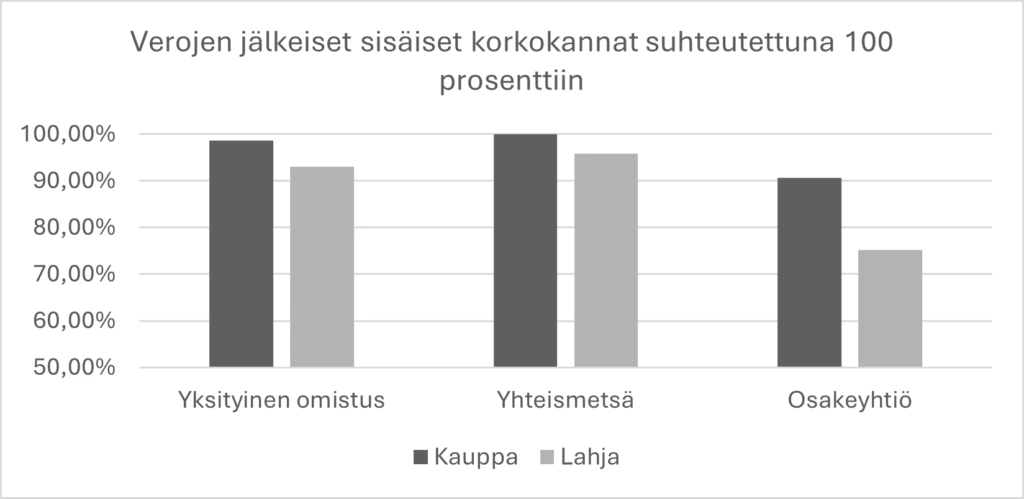
Overall, based on the assumptions used in the study, ownership through a jointly owned forest proved to be the most profitable option on average (Figure 1). However, the difference compared with private ownership remained small over the 15-year study period, as the tax rates differed by only a few percentage points. Limited liability company ownership was the least profitable option in the comparison. Although a limited liability company has the lowest tax rate, it is not eligible for the forest deduction. In addition, taxation of dividends or salaries must be taken into account if funds are withdrawn from the company for personal use. On average, selling the forest property proved more profitable than gifting it. However, if the intention is to transfer the forest to an heir, gifting remains a viable option even though it does not generate actual income for the donor.
Corporate ownership is the most suitable option for those actively trading forest properties, as any forest deduction previously claimed is added to the capital gain upon disposal. The forest deduction can therefore be regarded as an interest-free loan from the state. Ownership through a jointly owned forest appears to be best suited to multigenerational forest ownership. However, from an overall investment perspective, purchasing the right property at the right price may be more important than relatively small differences in taxation.
This study provides a framework for comparing different forms of ownership across different forest properties, taking into account their initial circumstances and even potential future plans. It therefore provides decision-making support when choosing the most appropriate form of ownership. The full thesis is available through the University of Eastern Finland’s thesis repository.
It is advisable to seek professional assistance both when acquiring forest properties and when choosing the most suitable form of ownership.
Let’s talk about forest investment
Want to know what this means for your forest assets or investment objectives? Tell us about your situation and one of our experts will be in touch. We always start with analysis, not sales.

We process your personal data in accordance with our privacy policy.