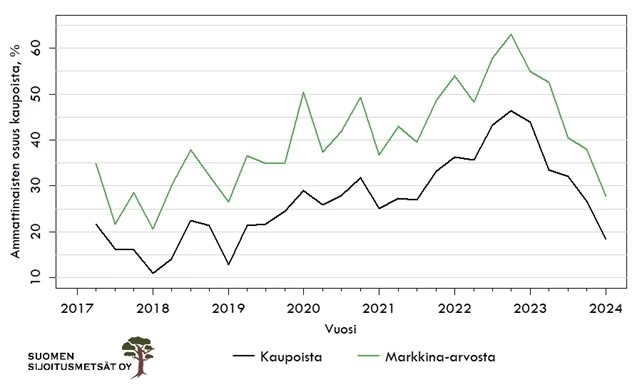

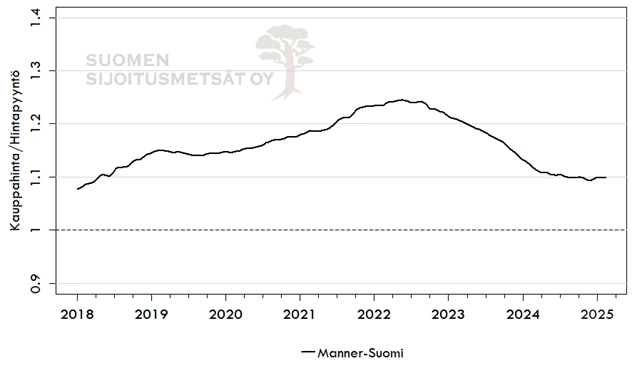
Figure: Average ratio of transaction prices to asking prices in the forest property market in mainland Finland over the preceding 12-month period.
In recent years, forest property buyers have become accustomed to having to bid above the asking price to win a competitive bidding process. Although the basic situation remains the same, the gap between transaction prices and asking prices has narrowed considerably.
Over the past 12 months (February 2024 – January 2025), completed forest property transactions have averaged approximately 10% above asking prices. This gap is clearly smaller than two or three years ago, when transaction prices were on average as much as 25% higher than asking prices.
In recent years, forest property prices have fluctuated considerably, moving from rapid increases to slight declines and, more recently, showing early signs of renewed growth. Recent developments can be seen in the narrowing gap between transaction prices and asking prices. “Asking prices tend to follow changes in market prices with some delay, so during a declining market we saw relatively higher asking prices. This also contributes to some properties remaining unsold if the asking price is too high,” says Mika Venho, founder and CEO of Suomen Sijoitusmetsät. “Changes in the buyer base also affect how strongly asking prices influence bidding. For professional buyers, the asking price is a less important benchmark than it is for private bidders,” Venho continues.
The statistics include both indicative asking prices, where offers may be either above or below the asking price, and minimum prices that establish the lower limit for bids. Naturally, the difference between transaction prices and asking prices is greater for properties marketed with a minimum price.
The ratio between transaction prices and asking prices varies by region, with a clear trend: in Southern Finland, buyers generally have to pay more above the asking price than in Northern Finland, particularly in Lapland, where forest properties sell on average below their asking prices. This is partly, although by no means entirely, explained by regional differences in pricing practices: minimum-price pricing is used considerably more often in the south than in the north.
There is also considerable variation within individual regions. Even in Southern Finland, some properties can be purchased below the asking price, while others may sell for almost twice the asking price.
“There is considerable variation in the pricing of individual forest properties, and the market currently has an abundance of properties for sale. For this reason, it is extremely important – and financially worthwhile – for forest owners selling their property to use a professional who understands the market and current price levels,” Venho notes.
The press release was published through STT Info:
https://www.sttinfo.fi/tiedote/71013627/metsakiinteistoista-maksetaan-edelleen-hintapyyntoja-enemman-tinkivaraa-vain-pohjoisessa?publisherId=69818737&lang=fi
Let’s talk about forest investment
Want to know what this means for your forest assets or investment objectives? Tell us about your situation and one of our experts will be in touch. We always start with analysis, not sales.

We process your personal data in accordance with our privacy policy.