
The forest property market has had several strong years. Trading has been active and forest land price levels have risen substantially. However, the situation has now changed significantly due to rising interest rates and the general market environment. The end of zero interest rates in spring 2022 became visible in the forest property market a year later, as forest funds and investment companies reduced their property acquisitions.
In 2023, 1,681 publicly listed forest property transactions over 10 hectares were completed. This represents 8.6% fewer than in 2022 and 12.3% fewer than the average over the previous five years. Transaction volumes in the first half of the year were close to average, but declined in the second half, particularly in November and December.
The low transaction volume was not due to lack of supply, as 2,299 properties over 10 forest hectares came to market last year – the highest number since market monitoring began in 2016, and 7.3% more than in 2022.
“Although market volume decreased significantly at the national level, trading in Southern Finland was 12.0% higher than in the previous year. This shift in market focus toward the south also affects the average transaction prices calculated per hectare and per cubic metre, as significantly more is paid for forest land and cubic metres of timber in the south than in the north,” says Eero Viitanen, Head of Forest Information at Suomen Sijoitusmetsät. “Changes in the market price level are therefore better measured with a market price index that adjusts for changes in regional supply and property characteristics than with average hectare prices.”
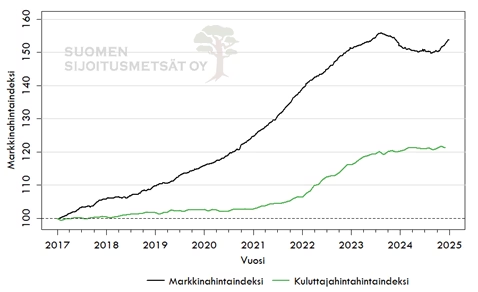
The Suomen Sijoitusmetsät Market Price Index has risen by an average of 5.8% a year over the past five years, with the steepest increase of 11.0% occurring in 2021. The long-running price level increase ended in August 2023, although on an annual basis, forest property price levels in 2023 remained 0.6% higher than the previous year. Price levels declined most in Southern Finland, where they fell 2.2% compared to the previous year, while in Lapland price levels rose as much as 8.4%. Lapland’s divergent price level development is largely due to the region’s thin market as transaction volumes continue to decline.
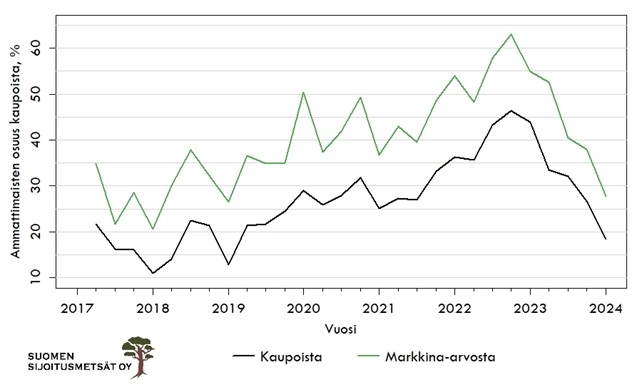
Professional buyers – forest funds and investment companies – have been a significant factor in the forest property market in recent years. At their peak, in the third quarter of 2022, they acquired 46% of all publicly listed properties by volume and 63% by value (Figure 1). In the final quarter of 2023, professional buyers accounted for only 18% of transactions by volume and 28% by value, the smallest shares since the end of 2018.
“As professional buyers’ transactions are clearly weighted toward larger-scale forest properties, the price level of more valuable properties has fallen more than the average,” Viitanen says.
“However, it now appears that the interest rate peak has passed as inflation trends toward the ECB’s target. The average real expected return of 4% for forest investments is starting to look attractive again for those who value diversification benefits,” predicts Mika Venho, founder of Suomen Sijoitusmetsät.
Follow this link to read the press release on the STT website.
Let’s talk about forest investment
Want to know what this means for your forest assets or investment objectives? Tell us about your situation and one of our experts will be in touch. We always start with analysis, not sales.

We process your personal data in accordance with our privacy policy.